You walk over to adjust the temperature, and either the screen is completely blank, or you hear the familiar “click” but the air conditioner or furnace refuses to turn on. A thermostat not working is one of the most common HVAC complaints homeowners face, but before you call a technician and pay a $150 service fee, you should know that many thermostat issues are incredibly simple to fix yourself, adds Hometown Holdings experts.
Quick Answer: If your thermostat is not working, the most common causes are dead batteries, a tripped circuit breaker, a blown furnace fuse, or a triggered safety float switch in your AC drain pan. If you recently installed a smart thermostat, the issue is almost certainly a missing or improperly connected C-wire.
To save you time, we have created a diagnostic tree. Find your specific symptom below to jump straight to the solution.
Thermostat Diagnostic Tree: What Is the Symptom?
Not all thermostat failures are the same. Whether your thermostat stopped working suddenly or has been acting up for weeks, use this table to identify your exact problem:
| The Symptom | What It Usually Means | Where to Look First |
| Screen is completely blank | The thermostat has lost power. | Check batteries, circuit breaker, and the furnace fuse. |
| Screen is on, but HVAC won’t run | Communication failure or safety lockout. | Check the AC float switch, wiring connections, and HVAC power. |
| Temperature reading is way off | Poor placement or a failing sensor. | Check for drafts, direct sunlight, or a dirty interior. |
| Short cycling (turns on and off rapidly) | Wiring issue or thermostat location. | Check the C-wire (if smart thermostat) and placement. |
Scenario 1: The Thermostat Screen Is Blank
If the display is dead, the thermostat is not receiving power. This is the most common reason a thermostat is not working. Here are the three things you need to check, in order of likelihood.
1. Dead Batteries
Many traditional and programmable thermostats rely on AA or AAA batteries. Even if your thermostat is hardwired to the wall, it may use batteries as a backup. Pull the faceplate off the wall (most pull straight off with a gentle tug) and replace the batteries. If the screen lights up, you are done.
2. Tripped Circuit Breaker
If your thermostat does not use batteries, it gets its power directly from the HVAC system’s transformer. A thermostat not working after a power outage is often caused by a tripped breaker. Go to your home’s main electrical panel and look for the breakers labeled “AC,” “Furnace,” “Air Handler,” or “HVAC.” If one is tripped (sitting in the middle position), turn it fully off, then back on. If it trips again immediately, stop. You have a short circuit and need a professional.
3. The Blown Furnace Fuse: The $1 Fix Most Homeowners Miss
If the breaker is fine and there are no batteries, you likely have a blown low-voltage fuse. This is a hidden cause that most homeowners do not know about.
Inside your furnace or air handler, on the main control board, there is a small, automotive-style blade fuse (usually 3-amp or 5-amp, purple or orange). This fuse protects the control board from electrical shorts in the thermostat wiring. If you recently tried to install a new thermostat without turning off the power, or if a dog chewed a wire outside, this fuse will blow silently. The result? A completely blank thermostat.
You can buy a replacement fuse at any auto parts store for about a dollar. Turn off the power to the furnace, open the panel, locate the blown fuse on the circuit board, and replace it.
Scenario 2: Thermostat Is On, But HVAC Won’t Run
This is arguably more frustrating. The screen is lit, you set it to “Cool,” you hear the click, but nothing happens. When a thermostat is not working in this way, the thermostat is trying to do its job, but the signal is being blocked somewhere between the thermostat and the equipment.
1. The Safety Float Switch (AC Only)
If you are trying to run the air conditioner and nothing happens, check your indoor unit’s condensate drain pan. If the drain line gets clogged with algae, water backs up into the pan. To prevent your ceiling from flooding, a small device called a safety float switch trips when the water gets too high. This switch intentionally cuts the power signal from the thermostat to the AC unit.
If the pan is full of water, clear the drain line with a wet/dry vacuum or vinegar. Once the water drains, the float switch will drop, and the thermostat will regain control of the AC.
2. The R/Rc Wire Selector Tab
If you recently installed a new thermostat yourself, a tiny switch might be your only problem. Many thermostats have an “R” wire (power for heat) and an “Rc” wire (power for cooling). If you only have one R wire coming from the wall, the thermostat needs a jumper to connect R and Rc.
“Hello, please be kind and use very simple terminology… Back in January I installed a new thermostat… The heat worked great, but now our AC does not turn on. I have checked the batteries, checked the circuit breaker, put in a new filter, and tried out different positions in the wiring…”
— u/Jazzlike_Formal_4923, r/hvacadvice (source)
The solution to this user’s problem was incredibly simple, as pointed out by another Reddit user:
“That little blue tab on the bottom right needs to be slid up. That should do it.”
— u/ralphembree, r/hvacadvice (source)
Check your thermostat’s manual to ensure the jumper wire or selector tab is in the correct position for your specific wiring setup.
The C-Wire Problem: Why Smart Thermostats Stop Working
If you upgraded to a Nest, Ecobee, or Honeywell smart thermostat and it suddenly stopped working, the culprit is almost always the C-wire (Common wire). This is the single most underdiagnosed reason why a thermostat is not working after a DIY upgrade.
Older thermostats only needed four wires (R for power, G for fan, Y for cooling, W for heating) because they ran on batteries. Smart thermostats have bright Wi-Fi screens that require continuous 24-volt power. The C-wire provides the return path for this continuous power.
If you installed a smart thermostat without a C-wire, it tries to “steal” power by pulsing the heating or cooling circuits. This works for a while, but eventually, the internal battery drains, the screen goes blank, or the HVAC system starts short-cycling. You must either run a new 5-wire cable from the furnace or install a C-wire adapter kit (often included with the thermostat).
Is Your Thermostat in the Wrong Location?
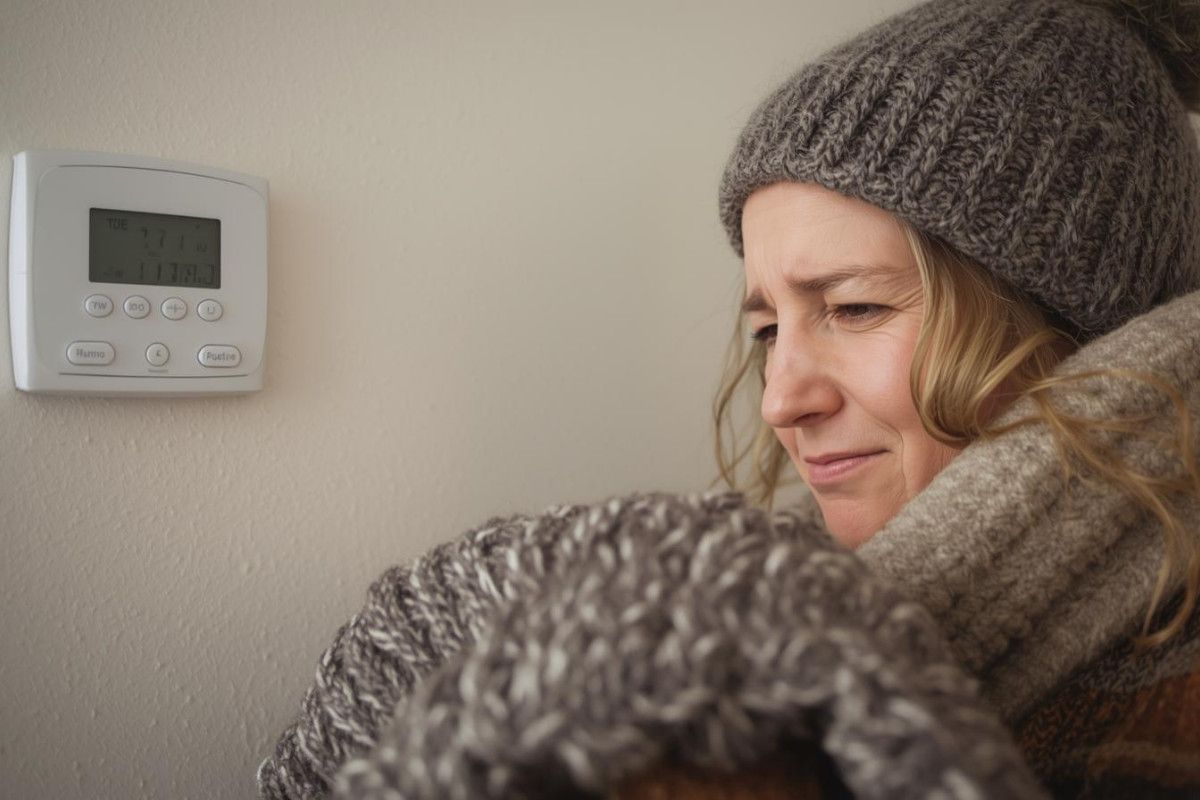
Sometimes the thermostat is working perfectly, but it is receiving bad data. If your house is freezing but the thermostat says it is 75 degrees, look at where the thermostat is mounted.
- Direct Sunlight: If the sun hits the thermostat in the afternoon, it will artificially inflate the temperature reading, causing the AC to run non-stop.
- Near a Supply Vent: If cold air blows directly onto the thermostat, it will think the house is cool and shut off prematurely.
- Drafty Hallways: A thermostat near a frequently opened exterior door will struggle to maintain a consistent temperature.
If location is the issue, you will need to have an HVAC professional relocate the thermostat to a central, interior wall away from drafts and direct sunlight.
While adjusting your current system’s setup can solve many comfort issues, some homeowners find that traditional central heating and cooling struggle to maintain consistent temperatures in specific areas like sunrooms or additions. In these cases, moving a thermostat may not be enough to fix the underlying airflow problem. Supplementing your home with a ductless ac installation in woodbridge can provide independent temperature control for those difficult spaces without requiring extensive ductwork modifications. This approach allows you to manage comfort levels more precisely in rooms that the main thermostat might otherwise misread or underserve.
Poor placement is a surprisingly common reason why a thermostat is not working as expected even when the hardware is perfectly fine.
When temperature readings remain inaccurate or the system struggles to engage properly, checking the underlying electrical connections and unit functionality becomes the next logical step. Homeowners seeking professional diagnostics can continue reading to discover how experts accurately assess communication faults or sensor problems. Ensuring that the entire heating configuration functions in harmony helps stabilize your indoor environment and prevents minor electrical glitches from causing sudden breakdowns.
When temperature readings remain inaccurate or the system struggles to engage properly, checking the underlying electrical connections and unit functionality becomes the next logical step. Homeowners seeking professional diagnostics can count on ONEWAY Heating & Air Conditioning to accurately assess communication faults or sensor problems. Ensuring that the entire heating and cooling configuration functions in harmony helps stabilize your indoor environment and prevents minor electrical glitches from causing sudden breakdowns.
When to Call a Professional
If you have checked the batteries, the breakers, the furnace fuse, and the float switch, and your thermostat is still not working as expected, it is time to call a pro. The issue could be a broken wire inside the wall, a failed transformer on the furnace control board, or a hardware failure within the thermostat itself.
Ongoing system care is just as important as fixing a broken thermostat. While many homeowners only focus on the digital screen, the mechanical health of the air handler and outdoor unit determines how well that thermostat can regulate your home. Regular maintenance helps identify minor electrical issues or worn components before they trigger a system lockout. If you need assistance with seasonal tune-ups or complex repairs beyond simple troubleshooting, connecting with the team at Complete Heat and Air can ensure your entire setup is functioning efficiently. Keeping the internal components clean and well-lubricated supports better communication between your controls and the equipment.
“That is a electrolytic surface mount 22 microfarad capacitor. Not soldered well, a cold joint, but would need to inspect more closely.”
— u/Dean-KS, r/thermostats (source)
As this Reddit user noted regarding a broken thermostat component, internal hardware failures usually mean the thermostat needs to be completely replaced. An HVAC technician can test the voltage at the wall to determine if the problem is the thermostat not working due to internal failure or a broader HVAC equipment issue.
Frequently Asked Questions
How do I know if my thermostat is bad or my AC is bad?
The easiest way to test this is to bypass the thermostat.
Testing the system manually can help determine if the hardware has failed or if there is a deeper electrical issue. In many cases, homeowners find that consistent maintenance and understanding their unit’s history can prevent these sudden disruptions. If you are interested in the background of a local service provider or want to see how long-standing expertise can improve your home’s efficiency, you can learn this here now to better understand the role of professional support. Having a reliable baseline for your HVAC performance ensures that when minor glitches occur, you can address them quickly without unnecessary stress or expense.
Why is my thermostat clicking but no heat comes on?
The click you hear is the relay inside the thermostat closing to send the signal to the furnace. If the heat does not come on, the thermostat is doing its job, but the furnace is failing to ignite. This is usually caused by a dirty flame sensor, a bad igniter, or a tripped limit switch in the furnace.
Can a bad thermostat cause the AC to freeze up?
Yes. If the thermostat’s temperature sensor fails, it may never send the signal to turn the AC off. When a thermostat is not working correctly in this way, the compressor runs continuously, eventually causing the evaporator coil to freeze into a block of ice. This is why a thermostat not working properly can cause secondary HVAC damage if left unaddressed.
Last modified: July 21, 2026