If your central AC is running but your house still feels hot, the problem is usually one of two things: the system is not making cold air, or it is making cold air but not moving enough of it through the home. The most common causes are a wrong thermostat or fan setting, a dirty or overly restrictive air filter, a blocked outdoor condenser coil, a frozen evaporator coil, low refrigerant from a leak, a failing capacitor, fan or compressor, duct leakage, a clogged condensate drain, or a home heat-load problem that the system can no longer overcome, explains Indiana Property Management experts.
When basic troubleshooting steps do not restore comfort, it is often necessary to consult with experienced specialists like Zack Hammonds A/C Heating Refrigeration Inc. to identify deeper mechanical or electrical faults. Professional technicians can perform comprehensive diagnostic tests on capacitors, contactors, and compressor health that are generally unsafe for homeowners to attempt. Getting an accurate reading on refrigerant levels and blower motor performance can help determine if a simple repair will suffice or if the system is nearing the end of its functional lifespan. Routine inspections can also reveal hidden duct leaks that significantly impact cooling efficiency and indoor air quality.
When an older cooling unit experiences frequent mechanical breakdowns or fails to maintain an acceptable temperature, simple maintenance may no longer be sufficient. Property owners facing persistent indoor climate issues often evaluate long-term options to restore efficiency. Investing in a new AC system installation in Deerfield Beach can provide improved energy efficiency and reliable cooling performance, ensuring lasting comfort during the hottest months of the year.
Maintaining complete home comfort involves monitoring both cooling and heating equipment throughout the year. When colder weather arrives, sudden breakdowns can compromise indoor safety just as severely as summer system failures. Homeowners who experience unexpected heating issues can rely on emergency furnace repair to quickly evaluate system safety, clean internal components, and restore steady warmth before severe winter conditions affect the household.
When technical complications threaten your system’s output, reviewing expert breakdowns can help clarify underlying mechanical faults. If you want to see standard cooling parameters or learn about professional baseline measurements for home climate systems, you can view it now to find resources detailing specific diagnostic approaches. Understanding these details helps residents verify their overall indoor comfort level.
The frustrating part is that several of these problems feel identical from the couch. You may hear the blower running, feel air at the vents, and still watch the indoor temperature creep upward. That is why the fastest path is not guessing. It is sorting the symptom into a pattern, checking what is safe to check, and knowing exactly what numbers to ask an HVAC technician to measure.
Start Here: Is the Air Warm, Weak, or Cold but Not Enough?
Before you open a panel or call for service, stand at a supply vent and pay attention to what the system is actually doing. A central air conditioner can fail in different ways, and the first clue is whether the air is warm, weak, cold-but-insufficient, or interrupted by ice, water, or short cycling.
| What you notice | Most likely direction | What to check first |
| Air from the vents is warm or room temperature | The system may not be removing heat at all. | Thermostat mode, outdoor unit operation, breaker, capacitor, compressor, refrigerant problem. |
| Air is cool but weak | The coil may be cold, but airflow is restricted. | Filter, return grille, frozen coil, dirty blower wheel, crushed duct, high-MERV filter restriction. |
| Air is cold and strong, but the house will not cool | The AC may be working, but the home or duct system is gaining too much heat. | Duct leakage, attic insulation, return leaks, humidity, sun exposure, recent load changes. |
| It cools at night but falls behind in the afternoon | The system may be marginal under peak load. | Outdoor coil dirt, low refrigerant, undersized or aging equipment, attic heat gain, leaky ducts. |
| Ice, water overflow, or sudden shutdown appears | The system may be protecting itself or losing airflow/refrigerant performance. | Turn cooling off, check the filter, look for drain issues, and call a professional if ice returns. |
This distinction matters because a house with 58°F air at one vent can still be uncomfortable if airflow is too low, ducts are leaking into the attic, or the return is pulling hot attic air. Likewise, a blower that sounds normal does not prove the outdoor unit is rejecting heat. A useful diagnosis starts with symptoms, not assumptions.
When temperature issues persist despite minor adjustments, a comprehensive physical assessment becomes necessary to locate underlying faults. Seeking local expertise from a qualified team like Fort Collins Heating and Air Pros can help ensure that subtle mechanical discrepancies are identified before they lead to unexpected breakdowns. Experienced technicians inspect the refrigeration loop, evaluate blower functionality, and provide clear data regarding actual performance metrics, helping property owners maintain lasting home comfort.
Quick Safety Check Before You Touch Anything
You can safely perform basic checks such as thermostat settings, filter condition, vent airflow, visible ice, outdoor clearance, and gentle debris removal around the condenser. You should not open the sealed refrigerant circuit, add refrigerant, attach gauges unless you are certified, bypass safety switches, work inside energized electrical compartments, or keep running a system with heavy ice, burning smells, repeated breaker trips, or water overflow.
The U.S. Department of Energy notes that when an air conditioner fails to cool adequately, a trained technician should check refrigerant charge, test for leaks, measure airflow across the evaporator coil, check duct leakage, and verify thermostat accuracy.1 EPA guidance is also clear that homeowners should ask technicians to locate and repair refrigerant leaks instead of simply topping off a leaking system, and refrigerant handling requires certified technicians.3
The 10 Most Likely Reasons Your Central AC Is Not Cooling
1. The Thermostat Is Set Wrong or the Fan Is Set to ON
Start with the boring check because it really does solve some calls. Confirm that the thermostat is set to Cool, the setpoint is lower than the current room temperature, and the fan is set to Auto, not On. When the fan is set to On, the blower can run continuously even when the compressor is not cooling, which makes the vents feel lukewarm between cooling cycles. Trane and several HVAC manufacturers list thermostat mode and fan setting as first checks when an AC is not blowing cold air.5
If the thermostat uses batteries, replace them if the screen is dim, blank, or behaving inconsistently. If you have a smart thermostat, check whether schedules, eco modes, utility demand events, or remote app settings changed the setpoint. A thermostat rarely explains weak airflow or ice, but it can explain a system that runs the fan without active cooling.
2. The Air Filter Is Dirty or Too Restrictive
A dirty air filter is not just a housekeeping issue. DOE explains that dirty, clogged filters reduce airflow and system efficiency; when airflow is obstructed, dirt can bypass the filter and accumulate on the evaporator coil, reducing its ability to absorb heat.1 In practice, this can make your central AC run longer, cool less, freeze the indoor coil, and raise the temperature in the house even while the blower is running.
Pull the filter and look at it under light. If it is gray, matted, damp, collapsed, or you cannot see light through it, replace it. If the problem started after installing a very high-MERV filter, the filter may be too restrictive for your return duct and blower setup. ENERGY STAR recommends inspecting, cleaning, or changing central AC filters once a month, and notes that dirty filters can increase energy costs and damage equipment.2
3. The Outdoor Condenser Coil Is Dirty or Blocked
Your indoor coil absorbs heat from the house, but the outdoor condenser has to reject that heat outside. If grass clippings, cottonwood, leaves, pollen, lint, or landscaping block the coil, the system cannot release heat efficiently. DOE says outdoor condenser coils can become very dirty, especially in dusty environments or near foliage, and recommends keeping the area around the condenser clean and trimming foliage back at least two feet for adequate airflow.1
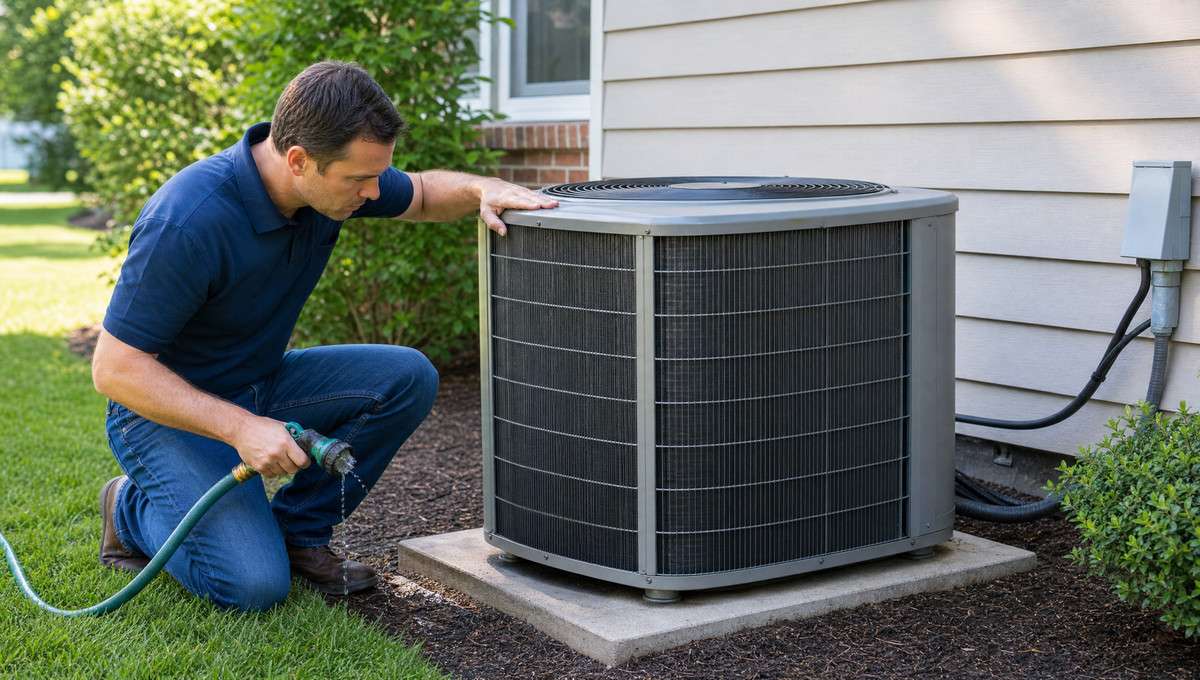
With power off, remove loose debris around the unit. You can gently rinse the coil from the outside with a garden hose, but do not use a pressure washer because bent fins restrict airflow. When the AC is running normally, the outdoor fan should spin and the air blowing out of the top should feel warm because heat is being rejected from your home. If the fan is not spinning, the unit hums, or the air is not warm, call for service.
4. The Evaporator Coil Is Frozen
A frozen evaporator coil is one of the most common reasons a central AC runs but does not cool. Ice blocks airflow across the indoor coil, so the blower may run while very little conditioned air reaches the rooms. Signs include weak airflow, water around the indoor unit after thawing, frost on the copper refrigerant line, or visible ice near the coil cabinet.
Turn cooling off and set the fan to On only if airflow is still moving, then allow the coil to thaw. Do not chip ice with tools. A frozen coil is usually a symptom, not the root cause. The underlying problem may be a clogged filter, dirty coil, low blower airflow, blocked return, low refrigerant, or a metering-device issue. If the coil freezes again after you replace the filter and restore airflow, stop running the AC and call a technician.
5. The System Is Low on Refrigerant or Has a Refrigerant Leak
Central air conditioners do not “use up” refrigerant the way a car uses fuel. If refrigerant is low, it usually means the system was undercharged, improperly serviced, or has a leak. Low refrigerant can cause warm supply air, poor cooling on hot days, long runtimes, ice on the coil or line, and eventually compressor damage.
EPA advises homeowners to request that service technicians locate and repair leaks instead of topping off leaking systems, because repairing leaks improves performance, reduces future service calls, and reduces refrigerant emissions.3 You should not add refrigerant yourself. Refrigerant is regulated, and charging a system correctly requires certification, pressure and temperature readings, and knowledge of the equipment’s design.
6. A Capacitor, Contactor, Outdoor Fan, or Compressor Is Failing
If the thermostat calls for cooling but the outdoor unit does not run properly, the indoor blower may push room-temperature air through the house. A bad capacitor can prevent the compressor or condenser fan from starting. A worn contactor can interrupt power to the outdoor unit. A failed outdoor fan prevents heat rejection. A failing compressor can leave the system running without meaningful cooling.
From the outside, clues include humming without the fan starting, repeated clicking, a fan that spins slowly, a breaker that trips, or an outdoor unit that runs but does not blow warm air upward. These are not good DIY repair targets because the outdoor unit contains high voltage and capacitors that can hold a charge. Document what you see and call an HVAC technician.
When complex component issues emerge in regions experiencing intense seasonal heat, securing expert assistance helps prevent secondary system issues. Homeowners seeking professional diagnostics can view our service to verify operational settings and restore efficient cooling performance. Experienced technicians utilize precision measurement tools to test performance data safely, which limits excessive wear and supports long-term equipment durability during peak conditions.
7. Airflow Is Weak Because of the Blower, Fan Speed, or Duct Restrictions
Sometimes the refrigeration side is working, but the blower cannot move enough air across the coil and through the duct system. ENERGY STAR says cleaning and adjusting blower components supports proper airflow and comfort, and that airflow problems can reduce system efficiency by up to 15 percent.2 A dirty squirrel-cage blower wheel, incorrect fan speed, clogged return, crushed flexible duct, closed dampers, or undersized return duct can all make the central AC feel weak.
The clue is a large temperature drop with poor volume. The air may feel cold at the closest register, but the rooms do not cool because too few cubic feet of air are circulating. This is also why simply measuring one vent temperature is not enough. A technician may need to measure static pressure, blower speed, total external static pressure, duct restrictions, and airflow across the evaporator coil.
8. Ducts Are Leaking, Disconnected, or Pulling Hot Attic Air
Duct problems are easy to miss because the equipment can test “fine” while the house stays hot. A supply duct disconnected in the attic can dump cold air outside the living space. A return leak in an attic can pull 120°F attic air into the system. Crushed flex duct can starve one side of the house. Poorly sealed duct joints can reduce delivered cooling even if the AC itself is operating.
If it is safe to access your attic, look from a distance for obvious disconnected ducts, torn flex duct, crushed runs, or insulation blown away from ductwork. Do not crawl into unsafe attic spaces during extreme heat. If the issue began after roof work, remodeling, pest activity, or someone working in the attic, mention that to the technician.
9. The Condensate Drain Is Clogged or a Float Switch Has Shut the System Down
Air conditioners remove humidity as they cool. That moisture drains into a pan and out through a condensate line. DOE notes that clogged drains can reduce the unit’s ability to remove condensed water, cause equipment shutdown until the drain is cleared, or lead to water damage where the blocked drain overflows.1 Trane likewise lists clogged condensate drain lines among common reasons an AC may not blow cold air, especially where a safety switch shuts down the indoor unit.5
If you see water around the indoor air handler, a full emergency drain pan, or a float switch tripped near the unit, turn the system off and address the drain before running cooling again. Water near electrical equipment and ceilings is not something to ignore.
10. The Home’s Heat Load, Humidity, Insulation, or Sizing Has Changed
Sometimes the AC is producing cold air, but the house is gaining heat faster than the system can remove it. This can happen in a poorly insulated attic, with leaky ducts, new west-facing glass, failed attic ventilation, missing weatherstripping, open fireplace dampers, high indoor humidity, or a single-hose portable AC that pulls hot outdoor air into the home. It can also happen when an older system has lost capacity but has not completely failed.
Humidity makes this feel worse because the system must remove moisture before the temperature drop feels comfortable. A long-running system is not automatically bad; longer cycles can improve dehumidification when the equipment is operating correctly. But if your AC used to hold 72°F and now cannot hold 78°F under similar weather, something changed. Treat that as evidence, not imagination.
The 15-Minute Homeowner Triage Test
This test is designed to help you collect useful evidence without doing unsafe HVAC work. It will not replace professional diagnosis, but it can tell you whether you are dealing with a simple setting problem, an airflow issue, a likely refrigerant/mechanical issue, or a building-load problem.
| Step | What to do | What the result may mean |
| 1 | Set thermostat to Cool, setpoint 3–5°F below room temperature, fan Auto. | If cooling starts normally, the issue may have been mode, schedule, batteries, or fan setting. |
| 2 | Inspect and replace the filter if dirty, damp, collapsed, or overly restrictive. | If airflow improves, the system was likely starved for return air. |
| 3 | Feel airflow at several supply vents and at the return grille. | Weak airflow points toward filter, blower, frozen coil, dampers, or duct restrictions. |
| 4 | Measure return-air temperature near the return and supply-air temperature at a nearby supply vent. | A rough 15–22°F drop is often a practical target, but airflow and humidity affect the reading. |
| 5 | Look at the outdoor unit while cooling is called. | The fan should spin and discharge warm air; no fan, humming, or no warm discharge requires service. |
| 6 | Check for obvious outdoor coil blockage and two feet of clearance around the unit. | Blocked airflow can make the system fall behind on hot afternoons. |
| 7 | Look for ice on refrigerant lines or the indoor coil cabinet. | Ice means turn cooling off; recurring ice needs professional diagnosis. |
| 8 | Look for water in the emergency pan or around the indoor unit. | A clogged drain or float switch may be interrupting operation. |
The temperature split deserves a careful explanation. Many technicians use the difference between return air and supply air as one clue. Around 15–22°F is commonly treated as a practical cooling range in the field, but it is not a complete diagnosis. A low split can suggest low refrigerant, poor heat exchange, duct heat gain, or excessive airflow. A very high split with weak airflow can point toward airflow restriction. The number is most useful when paired with airflow, humidity, refrigerant readings, and duct condition.
Reddit Cases That Explain Why This Problem Feels So Confusing
Real homeowner stories show why generic advice often disappoints. Many people are not dealing with a totally dead AC. They are dealing with a system that runs, sort of cools, and still leaves the house uncomfortable.
“AC set to 71 but the house will be 75 degrees by noon. In the middle of the afternoon it’s getting up to 77-78, even 80 degrees yesterday which is unbearable. It does get back down to 71 at night… HVAC guy said everything was functioning just fine and there should be no issues, except it’s 78 degrees in here and I’m sweating in front of a fan as I write this.” — u/throwaway12120105, r/hvacadvice (source)
This is the classic “works at night, fails under load” complaint. It can be caused by a dirty condenser coil, low refrigerant, airflow restriction, attic heat gain, duct leakage, insulation problems, or a system that has lost capacity. The important point is that “it runs” and “it is fine” are not measurements. If the home used to hold temperature and now cannot, ask for numbers: supply temperature, return temperature, static pressure, refrigerant readings, condenser temperature split, duct condition, and blower performance.
“You say the air coming from the vents is 50-60 degrees but the house still doesn’t get below 85? Something’s fucky for sure. In HVAC parlance, that’s a called a ‘high delta T’. Generally you want to see the difference between the supply (cold) air and return (warm) somewhere near 20°. In your case it sounds like it’s 25°-35°. The standard thing to suspect when there’s high delta T is poor airflow.” — u/truthsmiles, r/hvacadvice (source)
That comment captures a point many thin troubleshooting articles miss. Very cold vent air does not always mean strong cooling delivery. If the system is moving too little air, the coil can make the air cold while the house still receives too little total cooling. In that situation, filter restriction, blower speed, dirty blower wheel, blocked return, frozen coil, or duct restrictions deserve attention.
“The air coming out of the vents is around 59, which is just about perfect. The thermostat is set to 72. The system kicked on when the indoor temperature hit 73, and it’s been running for an hour — and it’s still not down to 72 yet… This is a 1950s house with poor insulation, so I assume that’s the culprit. But … it’s always had poor insulation, and this hasn’t happened in the past.” — u/713ryan713, r/HomeImprovement (source)
This case shows why history matters. If the same house, same system, and similar weather used to cool well, then poor insulation alone may not be the full answer. The better question is what changed: humidity, filter type, return leakage, duct damage, coil cleanliness, refrigerant charge, blower performance, thermostat location, or new heat sources.
When to Call an HVAC Technician Immediately
Some AC problems are not safe or practical for homeowners to solve. Call for professional service if the outdoor unit hums but will not start, the breaker trips, the coil freezes repeatedly, refrigerant lines are icy or room temperature while the system runs, the system is blowing warm air after basic thermostat and filter checks, the drain pan is overflowing, you smell burning, or the compressor/fan behavior looks abnormal.
| Symptom | Possible cause | What to ask the technician to measure or verify |
| Warm air from vents while system runs | Outdoor unit, compressor, refrigerant, reversing valve, thermostat wiring. | Refrigerant charge, superheat/subcooling, compressor operation, capacitor and contactor readings. |
| Cold but weak airflow | Filter restriction, frozen coil, dirty blower, duct restriction, wrong fan speed. | Total external static pressure, blower speed, coil condition, airflow across evaporator. |
| Cold air but house temperature rises | Duct leakage, return leak, attic heat gain, low capacity, high humidity. | Duct inspection, return leakage, temperature split, refrigerant readings, Manual J/load concerns. |
| Ice on indoor coil or suction line | Low airflow, low refrigerant, dirty coil, metering-device issue. | Filter/coil/blower condition, refrigerant leak test, charge verification after thawing. |
| Outdoor fan not spinning or unit humming | Capacitor, motor, contactor, electrical issue. | Capacitor microfarads, motor amperage, contactor voltage, compressor start components. |
| Water around indoor unit | Clogged condensate drain, cracked pan, frozen coil thawing. | Drain line clearing, float switch, pan condition, reason for any coil freezing. |
A good service visit should leave you with more than “everything looks fine.” You should receive measurements, observations, and a clear explanation of why the system is or is not delivering enough cooling to the living space.
How to Avoid Getting Told “Everything Is Fine” When It Is Not
When a central AC problem is intermittent or load-dependent, the technician may arrive when the system is behaving better. That does not mean your complaint is imaginary. Before the visit, record the outdoor temperature, indoor temperature, thermostat setpoint, time of day, runtime, supply-air temperature, return-air temperature, and whether the outdoor fan was running. Take photos of the filter, outdoor coil, ice, water in the pan, thermostat screen, and any suspicious duct conditions.
Then use a direct script: “The system used to hold 72°F in similar weather. Now it reaches 78–80°F by afternoon. I replaced the filter, confirmed Cool mode and Auto fan, and measured a supply temperature of X and return temperature of Y. Can you check airflow, static pressure, refrigerant charge, outdoor coil condition, duct leakage, and blower performance?” That turns the visit from a vague comfort complaint into a measurable performance problem.
Preventing the Same Problem Next Summer
Preventive maintenance does not guarantee that a capacitor will never fail or a leak will never develop, but it reduces the odds that a simple airflow or coil problem will turn into a no-cooling emergency. DOE says regular maintenance of filters, coils, fins, and refrigerant lines is essential for efficient and effective performance, and neglecting maintenance leads to lower performance and increased energy use.1 ENERGY STAR recommends annual preseason checkups, ideally before contractors become busy in peak summer or winter.2
In practical terms, check the filter monthly during cooling season, keep the outdoor unit clear, trim plants back at least two feet, keep supply and return vents open, have the condensate drain inspected, and schedule spring maintenance before the first heat wave. If your home has attic ducts, older insulation, comfort differences between rooms, or a history of “AC runs all day” complaints, ask about duct sealing, return-air leakage, attic insulation, and airflow measurement rather than focusing only on the outdoor unit.
FAQ: Central AC Running but Not Cooling
Why is my central AC running but not cooling?
Your central AC may be running without cooling because the thermostat or fan setting is wrong, airflow is restricted by a dirty filter or frozen coil, the outdoor condenser is dirty, the refrigerant charge is low, the outdoor fan or compressor is not working, or the duct system is losing conditioned air before it reaches the rooms.
Why is my central AC blowing cold air but not cooling the house?
If the air feels cold but the house will not cool, the system may not be moving enough air, the ducts may be leaking, the return may be pulling attic air, humidity may be high, or the home may be gaining heat faster than the AC can remove it. Cold vent air alone does not prove enough total cooling is reaching the living space.
Should I turn off my AC if it is not cooling?
Turn cooling off if you see ice, water overflow, repeated breaker trips, burning smells, or the outdoor unit is humming without starting. If the system is simply falling behind but airflow is normal and no ice or electrical symptoms are present, you can complete basic checks first, but do not keep forcing a clearly malfunctioning system to run.
Can a dirty filter stop central AC from cooling?
Yes. A dirty filter can restrict airflow enough to reduce cooling, increase energy use, and contribute to evaporator coil freezing. DOE specifically notes that dirty, clogged filters reduce airflow and efficiency and can allow dirt to accumulate on the evaporator coil.1
How do I know if my AC is low on refrigerant?
Possible signs include poor cooling, long runtimes, ice on the evaporator coil or suction line, room-temperature refrigerant lines while the system runs, and cooling that is worse on hot afternoons. These clues are not proof. A certified technician must test pressures, temperatures, superheat or subcooling, and should look for leaks rather than simply adding refrigerant.
Is it normal for central AC to struggle on very hot days?
Some temperature drift during extreme outdoor heat can happen, especially in older or poorly insulated homes. However, if your system used to maintain comfort under similar conditions and now cannot, treat that as a diagnostic clue. Dirty coils, low airflow, low refrigerant, duct leakage, and added heat load can all make a previously adequate system fall behind.
Can I add refrigerant myself?
No. Refrigerant charging is not a homeowner task. EPA states that Section 608 certification is required to recharge stationary appliances and that refrigerant for stationary appliances is sold only to certified technicians or the companies that employ them.3
What temperature should air from AC vents be?
There is no single correct vent temperature because it depends on return-air temperature, humidity, airflow, duct location, and system design. A practical homeowner check is the difference between return and supply air; roughly 15–22°F is often used as a field clue, but it must be interpreted with airflow and refrigerant data.
Why does my AC cool at night but not during the day?
Night cooling with afternoon failure often means the system is marginal under peak heat load. Common causes include a dirty outdoor coil, low refrigerant, restricted airflow, poor attic insulation, leaky attic ducts, high solar gain, or an aging system that has lost capacity.
What should I tell the HVAC technician?
Tell the technician the outdoor temperature, indoor temperature, thermostat setpoint, how long the system runs, whether it cools at night, whether airflow feels weak, whether you saw ice or water, and any supply/return temperature readings you collected. Ask for measured airflow, static pressure, refrigerant readings, coil condition, duct leakage findings, and electrical component readings.
Bottom Line
When your central AC is not cooling, the smartest first move is not to guess between refrigerant, filter, compressor, or insulation. The smartest move is to identify the symptom pattern. Warm air points toward refrigeration, outdoor-unit, thermostat, or electrical problems. Cold but weak air points toward airflow and freezing. Cold air that still does not cool the house points toward duct delivery, humidity, heat gain, or capacity. Once you know which pattern you have, you can make the safe checks yourself and call for service with the right evidence instead of starting from scratch.
References
- U.S. Department of Energy — Air Conditioner Maintenance
- ENERGY STAR — Maintenance Checklist
- U.S. Environmental Protection Agency — Homeowners and Consumers: Frequently Asked Questions
- Carrier — Why is My AC Not Blowing Cold Air?
- Trane — AC Not Blowing Cold Air
- Coolray — AC Troubleshooting: Why Is My Central Air Conditioner Not Cooling?
- AC & Heating Connect — Central AC Not Blowing Cold Air? Here’s What to Do
- Reddit r/hvacadvice — HVAC techs say my AC is fine, why is it not cooling my house?
- Reddit r/hvacadvice — AC not cooling house below 85. Techs tell us nothing is wrong.
- Reddit r/HomeImprovement — A/C blowing cold air but the house isn’t cooling
- Reddit r/hvacadvice — AC Unit is on but not cooling
Last modified: July 21, 2026