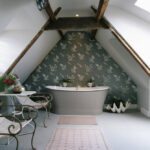
A small attic is not the same challenge as a large attic with a small budget, notes Keyrenter Overland Park team. A small attic is a space where the physical dimensions, not the money, limit what is possible. The usable floor area, the portion where the ceiling is at least 5 feet high, may be only 100 to 200 square feet. The peak height may be barely 7 feet. The width between the knee walls may be 6 to 8 feet. This is not a bedroom with a sitting area and a walk-in closet. This is a single-purpose room where every square foot must earn its place. The renovation of a small attic is an exercise in editing, not adding. The less that goes into the room, the larger it feels.
What “Small” Means in an Attic
An attic’s usable area is not the same as its footprint. A 25-foot-wide attic with an 8/12 roof pitch at the peak may have a total footprint of 500 square feet but only 150 square feet of usable floor area where the ceiling is above 5 feet. The rest is knee wall cavity and inaccessible sloped space. The renovation must work within the usable area. The knee wall cavities are storage, not living space. The sloped areas are visual space, not functional space. The room feels larger than it is because the ceiling extends beyond the usable floor into the sloped areas above the knee walls, but the floor area where furniture can be placed is limited to the central rectangle between the knee walls.
The most common small attic dimensions produce a usable rectangle of 8 to 12 feet wide by 15 to 20 feet long. That is 120 to 240 square feet. This is a single room. It is not a room with a closet. It is not a room with a sitting area. It is the room, and it must do one thing well.
Choose One Purpose and Commit
The most common mistake in small attic renovation is trying to make the space do too many things. A 150-square-foot attic cannot be a bedroom, a home office, and a yoga studio. It can be one of those things. Choose the purpose before the first piece of drywall goes up. The purpose determines the layout, the electrical plan, the storage design, and the furniture. A bedroom needs a bed, a nightstand, and a closet. A home office needs a desk, a chair, and shelving. A media room needs a sofa or floor seating and a screen wall. The purpose is singular. The renovation serves the purpose. Everything that does not serve the purpose does not go in the room.
Space-Saving Design Strategies
Built-Ins Over Freestanding Furniture
Freestanding furniture has legs that consume floor space, gaps behind it that collect dust, and a footprint that cannot be reduced. Built-in furniture is attached to the walls and sized exactly to the space. A built-in desk across the knee wall uses the knee wall as the back support and the knee wall cavity as knee space. It occupies zero additional floor area. A built-in bed platform between the knee walls uses the knee walls as the headboard and footboard. It eliminates the need for a bed frame, which in an 8-foot-wide attic would leave only 18 inches of walking space on either side.
Built-in shelving in the knee wall cavities provides storage without consuming floor space. The shelves are recessed into the wall. The books, clothing, or decorative objects sit inside the wall plane rather than projecting into the room. In a small attic, every inch of projection matters. A freestanding bookshelf that projects 12 inches into an 8-foot-wide room consumes 12.5 percent of the room width. The same books recessed into the knee wall consumes zero percent.
Low Furniture Keeps Sightlines Open
Per wikiHow’s guide, furniture that fits the scale of the room is essential in small spaces. In a small attic, furniture height is as important as furniture footprint. A low platform bed, 12 to 18 inches off the floor, leaves the upper half of the room open. The eye travels over the bed to the far wall, and the room feels larger. A standard bed frame with a tall headboard blocks the sightline at 4 feet off the floor, and the room feels like it stops at the headboard. Low-profile furniture applies to every piece in the room: low nightstands, low dressers, low shelving units. The space above 30 inches should be open air and light, not furniture.
Wall-Mounted Everything
Wall-mounted lights, wall-mounted shelves, and wall-mounted nightstands eliminate furniture legs from the floor. A floating nightstand attached to the knee wall provides a surface for a phone and a water glass without legs that take up floor space. A wall-mounted reading light eliminates the nightstand lamp, freeing the entire nightstand surface. In an 8-foot-wide attic, wall-mounted furniture on both sides saves 2 to 3 square feet of floor area, which is 3 to 4 percent of the total room. That is the difference between comfortable and cramped.
Light and Color: The Visual Expansion Toolkit
In a small attic, color does more work per square foot than in any other room. One light color on all surfaces, walls, ceiling, knee walls, makes the room read as a single volume. The boundaries between surfaces disappear. The room feels larger because the eye cannot measure it against contrasting edges. White is the most effective color for this. The palest warm gray or cream is the alternative if pure white feels too clinical.
A skylight, if the budget allows, transforms a small attic more than any other single renovation element. It brings natural light into the center of the room where walls cannot have windows. The light from above makes the ceiling feel higher. The view of the sky makes the room feel connected to the outside. In an 8-foot-wide attic with a 7-foot peak, a skylight is the difference between a room that feels like a tunnel and a room that feels like a refuge. The cost is $1,500 to $3,500 installed.
Common Small Attic Renovation Mistakes
- Dividing the space with walls. A 150-square-foot attic cannot be divided into two rooms. A wall that creates a 70-square-foot bedroom and a 60-square-foot office creates two rooms that are both too small to function. Keep the space open. Use rugs, lighting, and furniture arrangement to define zones within a single room.
- Dark flooring. A dark floor in a small attic absorbs light and makes the floor feel closer. Light-colored flooring, blonde wood-look LVP, pale carpet, or painted plywood, reflects light upward and makes the room feel taller.
- Too many windows or skylights. Natural light is critical, but every window consumes wall space that could hold furniture. In a small attic, one well-placed window or skylight is better than two that force the furniture into the center of the room where it blocks movement.
- Standard-height doors. A full-height door in a knee wall requires a header that drops below the sloped ceiling. A shorter door, 5 or 6 feet tall, in the knee wall accesses the storage cavity without the framing complexity of a standard door. The knee wall door is for storage access, not room entry. It does not need to be full height.
- Ignoring the peak as a feature. The peak is the highest point in the room. A ceiling fan or pendant light at the peak emphasizes the height. Painting the peak a darker color, which is sometimes done for dramatic effect in large attics, makes a small attic feel shorter. The peak should be the same light color as the rest of the ceiling.
Frequently Asked Questions
What is the smallest attic that can be renovated into a usable room?
A room needs roughly 70 square feet of usable floor area to function as a bedroom by code, and at least 50 square feet to function as a home office or reading nook by practical measure. An attic with less than 50 square feet of usable area is better finished as storage. The minimum dimension in any direction should be 6 feet to allow a piece of furniture or a walking path. An attic that is 5 feet wide and 15 feet long is a hallway, not a room.
How can a small attic serve more than one purpose?
Use furniture that transforms. A murphy bed folds up into the knee wall during the day and the room becomes an office. A desk folds down from the knee wall when needed and disappears when not. A storage ottoman provides seating, a footrest, and storage in a single piece. In a small attic, every piece of furniture must do at least two things. A chair that is only a chair is a luxury the square footage cannot afford.
The Small Room That Works
A small attic renovation is a design problem with a clear solution: choose one purpose, build in the furniture, keep the color light, and let the sloped ceilings do the architecture. The room will be small. That is not a flaw. It is a feature. The most memorable rooms in a house are not the largest. They are the ones with the most specific character. A small attic at the top of the stairs with a skylight over a built-in bed and books recessed into the knee walls is a room that no one forgets. The renovation cost is $10,000 to $25,000 for a 150-square-foot attic. The result is a room that feels larger than its square footage and more personal than any room with 8-foot flat ceilings on the floor below.
Last modified: July 25, 2026