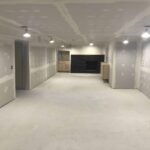
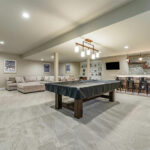
The basement walls are bare concrete. The moisture test passed. The rigid foam insulation is ordered. The next check you write is for framing. Framing is the first major trade in a basement finish, and its cost depends on three things: the linear feet of wall being framed, whether the framing is for exterior walls only or includes interior partition walls, and whether you do it yourself or hire a carpenter, highlights Dallas Management. This guide breaks down the cost of each approach with real numbers per linear foot and for a typical 800-square-foot basement.
Cost by Scope: Three Levels of Framing
| Scope | Linear Feet | DIY Materials | Pro Labor + Materials |
| Exterior walls only (furring or full frame around perimeter) | 80-120 | $400-1,200 | $1,600-4,800 |
| Exterior walls + 1 interior partition (bathroom/mechanical room) | 120-160 | $600-1,600 | $2,400-6,400 |
| Full layout (exterior + multiple rooms, hallway, closet) | 160-250 | $800-2,500 | $3,200-10,000 |
An 800-square-foot basement typically requires 120 to 180 linear feet of framed wall, depending on the floor plan. An open rec room with no interior walls is at the low end. A layout with a bedroom, bathroom, hallway, and mechanical room is at the high end.
Cost Per Linear Foot: Materials Breakdown
| Component | Cost per Linear Foot | Notes |
| Pressure-treated bottom plate (2×4) | $0.60-1.00 | Required for concrete contact |
| Standard top plate (2×4) | $0.40-0.70 | Kiln-dried, not pressure-treated |
| Studs (2×4, 16″ OC, 8-ft height) | $2.50-4.00 | One stud per 16 inches = 0.75 studs per linear foot |
| Fasteners (nails, Tapcons, powder loads) | $0.30-0.60 | ACQ-compatible for pressure-treated plate |
| Blocking and fireblocking | $0.30-0.50 | Mineral wool or solid blocking at top plate |
| Total materials per linear foot | $4.10-6.80 |
Materials for framing a basement wall cost $4 to $7 per linear foot. For 150 linear feet, the typical framing material cost is $600 to $1,000. Lumber prices fluctuate seasonally and regionally. These numbers assume standard 2×4 kiln-dried lumber at $3 to $4 per 8-foot stud. During lumber price spikes, material costs can increase by 30 to 50 percent.
Professional Framing Labor Costs
A framing carpenter charges $8 to $20 per linear foot for labor in addition to materials. The range reflects regional labor rates and whether the framing includes complex elements like soffits around ductwork, bulkheads, or curved walls. Standard straight walls with simple door openings are at the low end. Walls with multiple doorways, soffits, or built-in niches are at the high end.
For 150 linear feet of standard basement framing, labor costs $1,200 to $3,000. Materials add $600 to $1,000. The total professional framing cost for a typical basement is $1,800 to $4,000. A framing crew of two carpenters completes the work in 1 to 2 days. The speed is the value. The same work done by a homeowner working weekends takes 2 to 3 weekends.
DIY Savings on Framing
Framing is the most DIY-friendly phase of basement finishing. It requires basic carpentry skills that are learnable from a single YouTube video: measuring, cutting with a miter saw, nailing, and checking for plumb and level. The tools are a hammer or framing nailer, a miter saw, a 4-foot level, a chalk line, and a tape measure. The material cost is the same whether a carpenter or a homeowner buys the lumber. The savings are entirely in labor.
On 150 linear feet of framing, the DIY savings are $1,200 to $3,000. The cost of tools, if you own none of them, is about $200 for a miter saw, $30 for a level, $10 for a chalk line, and $10 for a tape measure. A framing nailer rents for $35 per day and is worth the rental for the speed increase over hand-nailing. Total tool cost for a first-time framer is $250 to $300, which is still less than the labor for a single day of professional framing.
Steel Studs vs. Wood: Cost Difference
Steel studs cost 20 to 30 percent more than wood studs for materials. The fasteners and tools are different, and the labor is slightly higher because steel studs require screws rather than nails. The total cost premium for steel stud framing is roughly $1 to $2 per linear foot over wood. For 150 linear feet, steel adds $150 to $300 to the material cost. Steel is chosen for basements because it does not rot or support mold. The cost difference is small relative to the peace of mind, particularly in basements with a history of moisture issues that have been resolved.
What Adds Cost to a Framing Job
Straight walls with standard 8-foot ceiling height are the baseline. These elements add cost per linear foot:
- Soffits and bulkheads around ductwork. The main HVAC trunk runs through the basement ceiling. Framing a soffit to hide it requires additional lumber, more complex cuts, and more labor. A soffit adds $3 to $5 per linear foot over standard wall framing.
- Pocket doors. A pocket door requires a pocket door frame kit and double the wall framing of a standard door opening. The kit costs $80 to $150 and the additional framing adds $30 to $50 in materials and an hour of labor.
- Curved or angled walls. Standard framing is rectilinear. A curved wall requires bending the top and bottom plates, which involves kerf-cutting the 2×4 every few inches or laminating thin plywood strips. Curved walls cost 3 to 5 times as much per linear foot as straight walls and are almost always a professional job.
- Ceiling height above 8 feet. Standard 8-foot studs cost $3 to $4 each. Studs for 9-foot ceilings cost $5 to $7 each and may need to be special-ordered. The cost difference per linear foot is roughly $1 to $2.
Frequently Asked Questions
Does framing require a separate permit?
Framing is covered under the general building permit for the basement finish. It does not require a separate permit. The framing is inspected as part of the rough-in inspection, along with the electrical and plumbing rough-in. The inspector checks stud spacing, fireblocking, and the attachment of the bottom plate to the concrete.
Why does lumber cost vary so much?
Lumber is a commodity traded on futures markets. Prices fluctuate with housing starts, tariffs, mill capacity, and seasonal demand. The framing lumber for a basement costs $600 one year and $900 the next based on factors entirely outside your control. Buy lumber when you are ready to frame, not months in advance. Storing lumber in a basement for weeks before framing allows it to absorb humidity and warp. Buy it the week you plan to start.
Is furring strips cheaper than full 2×4 framing for basement walls?
Yes. Furring strips, 1×3 or 1×4 boards attached directly to the concrete, cost $0.80 to $1.50 per linear foot in materials, roughly one-quarter the cost of full 2×4 framing. However, furring strips do not create a cavity for electrical wiring or additional insulation beyond the rigid foam on the concrete. If the wall needs electrical outlets, which most finished basements do, full 2×4 framing is required because electrical boxes need the 3-1/2-inch depth of a stud cavity. Furring is appropriate for a utility area or storage room where outlets are not needed. For living spaces, the additional cost of full framing is not optional.
The Bones of the Basement
Framing is the fastest and least expensive phase of a basement finish. The materials cost $4 to $7 per linear foot. The labor adds $8 to $20 per linear foot if hired. The total framing cost for a standard basement is $1,800 to $4,000 professionally or $600 to $1,000 in materials for DIY. The framing defines the rooms. Every wall that follows, drywall, paint, baseboard, exists because the framing was there first. The framing is the bones. Everything else is skin.
Last modified: July 16, 2026