Short-term rental owners left thousands of dollars on the table last year by missing deductions they were legally entitled to claim. The IRS allows you to deduct mortgage interest, property taxes, repairs, depreciation, and operating expenses on properties rented for fewer than 30 days — but the rules differ sharply from long-term rentals. Get them wrong, and you invite an audit. Get them right, and your tax bill drops significantly, emphasizes MHN Property Management Helotes.
The key distinction comes down to how you use the property yourself. Under the 14-day rule (sometimes called the Masters Exception), rent your place for two weeks or less and the income is completely tax-free — no reporting required. Rent it longer, and you enter the full world of vacation rental tax rules, IRS Publication 527, and Schedule E. This is where most new hosts get tripped up, confusing personal use with business use and missing deductions for furniture, appliances, and even home office space used to manage bookings.
This guide covers every major deduction category for short-term rental property tax deductions, from the straightforward (cleaning fees and utilities) to the advanced (cost segregation studies and the Qualified Business Income deduction under Section 199A). You will also find a practical checklist, answers to common questions about passive activity loss rules, and guidance on how to track expenses so nothing slips through at tax time.
What Qualifies as a Short-Term Rental for Tax Purposes?
The IRS classifies a short-term rental by how long guests actually stay, not by the property type or listing platform. If the average rental period is 7 days or less, the property is treated as a short-term rental for tax purposes. This classification determines which tax forms you file, which deductions you qualify for, and whether your rental income is subject to passive activity loss rules or self-employment tax. The distinction matters more than most new hosts realize — and getting it wrong can trigger an audit.
IRS Definition vs. Common Terms
The official rule comes from IRS Publication 527: a property is a short-term rental when the average guest stay is 7 days or less. This is a mathematical test, not a label. You calculate it by dividing total rental days by the number of rental periods in the year.
What many hosts don’t realize: the IRS doesn’t care if you call it a “vacation rental,” an “Airbnb,” or a “holiday let.” Those are marketing terms. The tax treatment hinges entirely on the average stay calculation.
| Classification | Average Stay | Tax Treatment |
|---|---|---|
| Short-term rental | 7 days or less | Rental activity (Schedule E). Not subject to self-employment tax if you meet material participation tests. |
| Medium-term rental | 8–30 days | Still rental activity, but fewer deduction categories available. No “hotel-like” services expected. |
| Long-term rental | More than 30 days | Standard residential rental. Passive activity loss rules apply fully. No 14-day rule exemption. |
A common mistake: hosts assume that because they list on Airbnb, the IRS automatically treats them as a short-term rental. Not true. If your average guest books for 10 nights, you fall into the medium-term category. That changes your deduction strategy — and your exposure to passive activity loss limits under Section 469.
Personal vs. Rental Use: The 14-Day Rule
The 14-day rule is the single most valuable tax break for short-term rental owners who use their property personally. Under the Masters Exception (named after a famous tax court case), if you rent your property for 14 days or fewer in a year, you don’t have to report any of that rental income to the IRS. None. Zero.
Here’s the catch: you also can’t deduct any rental expenses. The trade-off is clear — tax-free income in exchange for zero deductions. This rule applies only when you use the property personally for more than 14 days or 10% of the total rental days, whichever is greater.
In practice, the 14-day rule works best for homeowners in high-demand vacation areas who rent out their primary residence during a peak event. Think: Super Bowl host cities, the Masters golf tournament in Augusta, or the Kentucky Derby. One host in Scottsdale rented her home for 13 days during the 2023 Waste Management Phoenix Open and pocketed $18,000 tax-free.
What surprises many accidental landlords: the 14-day rule does not apply if you rent through a property manager who handles all guest interactions. The IRS looks at who bears the economic risk. If you’re truly renting out a spare room occasionally, the rule works. If you’re running a business with a cleaning crew and dynamic pricing software, you likely don’t qualify.
The IRS tracks personal use days tightly. Any
Top Tax Deductions for Short-Term Rental Owners
Short-term rental owners can deduct mortgage interest, property taxes, operating expenses, and depreciation to significantly lower their taxable income. The IRS treats properties rented fewer than 30 days under specific rules in IRS Publication 527. Claiming the right expenses separates a profitable investment from an audit risk.
Mortgage Interest & Property Taxes
Mortgage interest on a short-term rental is deductible on Schedule E, not Schedule A. This matters because Schedule E has no cap on investment interest deductions, unlike personal mortgage interest, which faces limits after the Tax Cuts and Jobs Act. You deduct the full interest paid on the loan used to acquire or improve the property.
Property taxes follow a similar path. Report them on Schedule E as a rental expense. One thing lenders rarely explain: if you use the property personally for more than 14 days or 10% of rental days, you must allocate taxes between personal and rental use. The personal portion moves to Schedule A and faces the $10,000 SALT cap. The rental portion avoids that cap entirely.
Repairs vs. Improvements
Repairs are deductible immediately. Improvements must be depreciated over 27.5 years (residential) or 39 years (commercial). The IRS draws a hard line here, and the distinction is based on whether the work restores condition or adds value.
| Expense Type | Deductible Immediately | Must Be Depreciated |
|---|---|---|
| Fixing a broken window | Yes | No |
| Replacing all windows | No | Yes |
| Patching a roof leak | Yes | No |
| New roof installation | No | Yes |
| Painting a single room | Yes | No |
| Full interior renovation | No | Yes |
A common mistake: treating a capital improvement as a repair. If you replace a water heater with an upgraded model, the IRS considers that an improvement. You depreciate it over 27.5 years. Keep separate receipts for repairs and improvements, auditors check this distinction closely.
Depreciation (Form 4562)
Depreciation is the single largest non-cash deduction available to short-term rental owners. You recover the cost of the building (not land) over 27.5 years using the Modified Accelerated Cost Recovery System (MACRS). Personal property inside the unit , furniture, appliances, bedding : gets depreciated over 5 or 7 years.
File Form 4562 with your tax return to claim depreciation. You must include the placed-in-service date and the depreciable basis (purchase price minus land value). What surprises many first-time hosts: if you don’t claim depreciation in the first year, the IRS treats it as if you did when you sell the property. You owe recapture tax anyway, so claim it from day one.
Operating Expenses
Operating expenses are fully deductible in the year incurred. These include cleaning fees between guests, laundry supplies, toilet paper, coffee, and welcome baskets. Utilities, internet, cable TV, and pool maintenance all qualify. Property management fees . typically 15-30% of booking revenue , are deductible.
Marketing costs matter too. Professional photography, listing optimization services, and paid ads on Google or social media count as ordinary business expenses. One edge case: if you manage the property yourself, mileage driven to restock supplies or meet contractors is deductible at the IRS standard rate (65.5 cents per mile for 2023, 67 cents for 2024).
Home Office Deduction
The home office deduction for short-term rental owners is more restrictive than most realize. You qualify only if you use a dedicated space exclusively and regularly for management activities . answering guest inquiries, handling bookings, tracking expenses. That spare bedroom doubling as an office? It must be used only for business.
Calculate using the simplified method ($5 per square foot, max 300 square feet, up to $1,500) or the regular method (actual expenses × percentage of home used for business). The regular method allows you to deduct a portion of mortgage interest, utilities, and insurance , but it requires meticulous rental property expense tracking. The simplified method is easier but caps your deduction. Most experienced hosts use the regular method when the space justifies it.
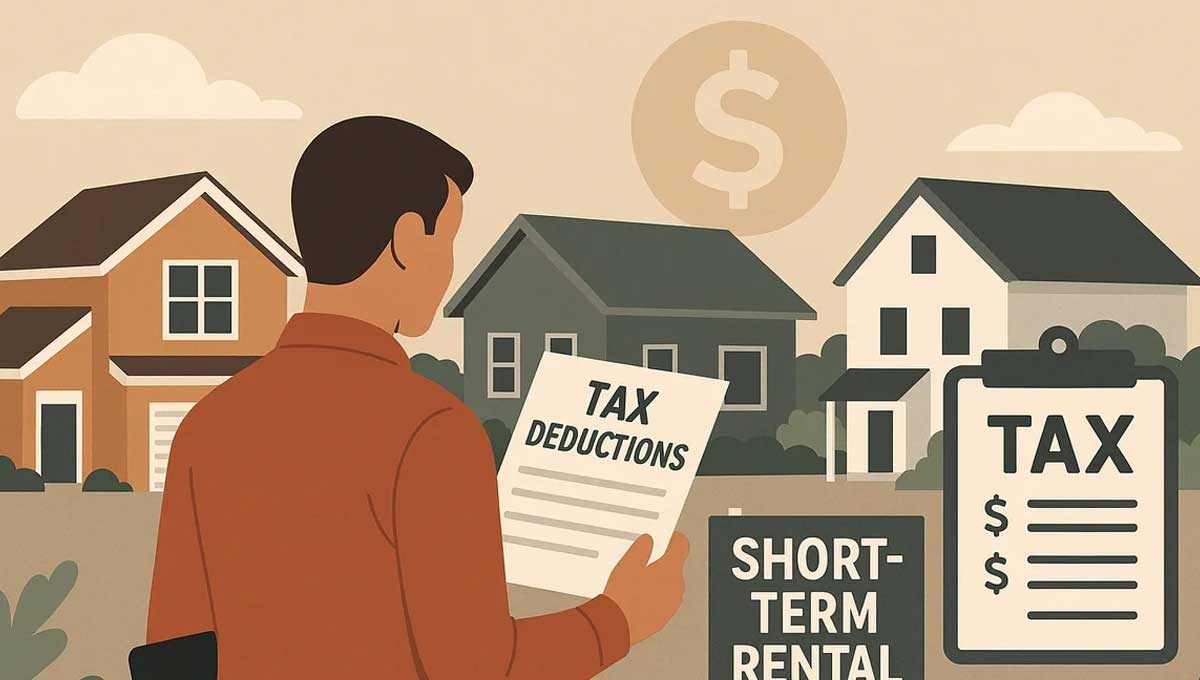
How to Report Short-Term Rental Income on Your Tax Return
Filing correctly starts with picking the right form. The IRS gives short-term rental owners two primary paths: Schedule E (Supplemental Income and Loss) or Schedule C (Profit or Loss from Business). The wrong choice can trigger an audit or cost you thousands in missed deductions.
Schedule E vs. Schedule C
Schedule E is the default for most short-term rental hosts. The IRS treats rental activity as passive by default, and Schedule E is where passive income and expenses are reported. You list gross rents, then deduct mortgage interest, property taxes, insurance, repairs, management fees, and depreciation (Form 4562).
Schedule C is for hosts who qualify as a real estate professional or who meet the material participation test. Under IRS rules, material participation requires you to be involved in the rental activity on a “regular, continuous, and substantial basis” : roughly 500 hours per year or more. If you hit that threshold, your short-term rental is treated as a business, not a passive activity.
This distinction matters because of the passive activity loss rules. On Schedule E, losses from your rental generally can’t offset your W-2 income unless you qualify for the real estate professional exception. On Schedule C, losses can offset active income directly.
A common mistake: assuming all Airbnb income goes on Schedule C. The IRS has consistently ruled that short-term rentals with average guest stays of 7 days or fewer are considered “rental real estate” for passive loss purposes, not a trade or business . unless you materially participate.
Form 1099-K from Airbnb/VRBO
Payment platforms like Airbnb and Vrbo issue Form 1099-K to hosts and to the IRS. For tax year 2024, the reporting threshold is $600 in gross payments , down from the previous $20,000 threshold. This means nearly every host will receive a 1099-K.
What many hosts don’t realize: the 1099-K reports gross bookings, not your net income. It includes cleaning fees you pay to cleaners, Airbnb service fees, and occupancy taxes collected on your behalf. You must reconcile this number on your return by deducting those fees and taxes.
State reporting adds another layer. Some states (like Vermont, Massachusetts, and Maryland) have lower thresholds or require separate occupancy tax filings. If you rent in a state with a local transient occupancy tax, you may need to file a separate return with that jurisdiction.
State-Specific Tax Considerations
State income tax treatment of short-term rental income varies widely. Some states follow federal rules closely; others do not. California, for example, does not conform to the federal 14-day rental rule ; meaning income from renting your home for fewer than 15 days may still be taxable at the state level.
Local occupancy taxes (often called “hotel taxes” or “transient occupancy taxes”) are a separate obligation. These are typically collected by the platform (Airbnb collects and remits in many cities), but not everywhere. If you manage your own bookings, you are responsible for registering with the local tax authority, collecting the tax, and filing monthly or quarterly returns.
IRS Publication 527 covers the federal rules for residential rental property. But for state-specific guidance, consult your state’s department of revenue or a local CPA who handles vacation rental tax rules. The penalties for missing state filings can exceed the federal penalties , especially for hosts in high-tourism areas like Florida, Colorado, or Tennessee.
Advanced Strategies to Maximize Your Deductions
Once you’ve mastered the basics : mortgage interest, repairs, operating expenses . the real tax savings begin. These three strategies require more planning but can reduce your tax liability by tens of thousands of dollars per property. They’re not for every host, but for experienced investors with multiple short-term rentals, they’re essential.
Cost Segregation Studies
A cost segregation study reclassifies components of your property from 27.5-year depreciation (residential real estate) to 5-, 7-, or 15-year depreciation (personal property and land improvements). The result: you front-load depreciation deductions in the first year you place the rental in service.
In practice, a $500,000 short-term rental might yield $60,000–$80,000 in accelerated first-year depreciation after a cost segregation study. That’s a deduction against ordinary income, not just rental income. The study itself costs $2,000–$5,000, but the tax savings often exceed $15,000 in year one.
What many hosts don’t realize: cost segregation works best for properties purchased new or substantially renovated. Older properties with existing improvements offer less to reclassify. The IRS requires a formal engineering-based study , DIY spreadsheets won’t hold up under audit. You’ll file Form 4562 with your Schedule E to claim the accelerated depreciation.
Qualified Business Income (QBI) Deduction (Section 199A)
The QBI deduction allows eligible owners to deduct up to 20% of their qualified business income from a pass-through entity. For short-term rentals, the key question is whether your activity qualifies as a “trade or business” under IRS rules.
Here’s where things get tricky. The IRS issued final regulations in 2019 (Treasury Decision 9849) clarifying that short-term rentals can qualify for QBI . but only if you meet material participation standards. You must participate in the rental activity for at least 500 hours per year, or your participation must constitute substantially all of the work performed. For hosts using property managers, this threshold becomes difficult to meet.
The deduction phases out at taxable income thresholds: $191,950 for single filers and $383,900 for married filing jointly (2024 figures). Above those levels, the deduction is limited by the property’s unadjusted basis and wages paid.
One thing lenders rarely explain: if you hold your short-term rental in an LLC taxed as an S-corporation, QBI eligibility improves because you can pay yourself a “reasonable salary” and treat the remaining profit as qualified business income. This adds complexity , payroll taxes, quarterly filings : but the 20% deduction often justifies the overhead for properties generating $100,000+ in annual net income.
1031 Exchanges
A 1031 exchange lets you defer capital gains taxes when you sell a rental property and reinvest the proceeds into a “like-kind” replacement property. For short-term rental owners, the critical requirement is that both the relinquished and replacement properties must be held for investment or business use . not primarily for personal use.
The IRS’s 2017 proposed regulations (REG-115534-12) clarified that vacation homes can qualify for 1031 exchanges, but the safe harbor requires you to rent the property for at least 14 days per year and limit personal use to the greater of 14 days or 10% of rental days. This aligns closely with the 14-day rule for tax-free rental income.
Tax Deduction Checklist for Short-Term Rental Hosts
This checklist covers every major deduction category allowed under IRS Publication 527. Use it before filing to ensure you haven’t missed anything that reduces your taxable income.
Property & Mortgage Costs
- Mortgage interest on loans used to buy, build, or improve the rental property (reported on Schedule E)
- Property taxes paid to state and local governments
- Mortgage insurance premiums (PMI or MIP)
- Title insurance and recording fees for the property purchase
- Points paid on refinancing (amortized over the loan term)
Depreciation & Capital Improvements
- Building depreciation (27.5-year recovery period for residential rental property)
- Furniture, appliances, and electronics (5- or 7-year property, Form 4562)
- Land improvements like fencing, driveways, and landscaping (15-year property)
- Cost segregation study costs (accelerates depreciation on personal property)
- Major improvements that extend useful life (roof replacement, HVAC, new windows)
Operating Expenses
- Cleaning fees and supplies (including linens, toilet paper, paper towels)
- Utilities (electricity, water, gas, trash removal, internet, cable)
- Property management fees and commission paid to platforms or managers
- Marketing and listing fees (photography, website hosting, paid ads)
- Insurance premiums (property, liability, umbrella, flood)
- Homeowners association (HOA) dues and condo fees
Repairs & Maintenance
- Repairs that keep property in working condition (plumbing, electrical, painting, appliance fixes)
- Pest control and extermination services
- Snow removal and lawn care
- Tools and equipment for maintenance (under $2,500 per item via de minimis safe harbor)
Travel & Vehicle Expenses
- Mileage driven for rental property management (standard rate: 67 cents per mile in 2024)
- Actual vehicle expenses (gas, maintenance, insurance) if you track business vs. personal use
- Travel costs to inspect or manage the property (airfare, lodging, meals at 50%)
- Local transportation (parking fees, tolls, public transit)
Home Office & Administrative
- Home office deduction (regular method or simplified method at $5 per square foot, max 300 sq ft)
- Office supplies, printer ink, software subscriptions (property management platforms)
- Legal and professional fees (accountant, tax preparer, attorney)
- Bookkeeping and accounting software costs
- Business licenses and permits (short-term rental registration fees)
Taxes & Filing Costs
- State and local occupancy taxes (transient occupancy taxes, hotel taxes)
- Property tax payments to local governments
Common Audit Triggers and How to Avoid Them
The IRS flags short-term rental returns for three main reasons: excessive personal use, inconsistent loss claims, and mismatched 1099-K income. Understanding these triggers is your best defense.
Excessive Personal Use: The 14-Day Trap
If you use the property for more than 14 days per year (or 10% of total rental days, whichever is greater), the IRS reclassifies it as personal-use property. This shifts your deductions from Schedule E to the far less favorable Schedule A, capping mortgage interest and eliminating most operating expenses.
Track every personal day. A “day” counts if you are present for any part of it , even a two-hour visit to check mail. One common mistake: counting maintenance days as personal. Days spent solely on repairs or cleaning do not count as personal use under IRS Publication 527.
Inconsistent Loss Claims and Passive Activity Rules
Short-term rentals are subject to passive activity loss rules. You cannot deduct losses that exceed your rental income unless you “materially participate” ; and the IRS scrutinizes this closely. Material participation requires you to spend more than 500 hours per year on the rental, or at least 100 hours with no one else spending more.
What many owners don’t realize: claiming a loss on Schedule E without meeting material participation is a direct audit flag. The IRS cross-checks your hours against industry averages. If you claim 600 hours but live 200 miles away, expect questions.
The 1099-K Mismatch
Airbnb and VRBO issue Form 1099-K if your gross payments exceed $600 (for 2024 and later). The IRS automatically compares this to your reported income. A mismatch , even by a few hundred dollars : triggers a computer-generated notice.
Reconcile every platform payout against your 1099-K before filing. Many owners forget to include booking fees that were deducted by the platform before payout. Those fees are not income, but the 1099-K shows gross payments, not net deposits.
How to Build Audit-Proof Records
Maintain a digital log for each property with three elements: a calendar marking personal vs. rental days, receipts for every expense over $75, and a mileage log for travel to the property. The IRS accepts contemporaneous records . created within 30 days of the event , far more readily than retroactive reconstructions.
“I got audited because I claimed 100% business use on a property I stayed in for 3 weeks. The IRS agent asked for my personal calendar. I didn’t have one. Cost me $4,200 in back taxes and penalties.”
, Reddit user, r/IndiaTax, April 2026
Use rental property expense tracking software that generates
Frequently Asked Questions
Can I deduct mortgage interest on a short-term rental?
Yes, mortgage interest on a short-term rental is deductible on Schedule E, but the rules differ from a primary residence. You deduct interest based on the ratio of rental days to total days used. If the property is rented 200 days and used personally 30 days, you deduct 200/230 of the total mortgage interest. The Tax Cuts and Jobs Act (2017) capped primary residence mortgage interest deductions on debt up to $750,000. For rental properties, that cap does not apply , interest on rental debt of any size is generally deductible as a business expense.
What is the 14-day rule for rental property?
The 14-day rule, also called the Masters Exception, allows you to rent your property for 14 days or fewer per year and keep all rental income tax-free. You report nothing to the IRS. Personal use exceeding 14 days or the greater of 14 days or 10% of rental days triggers different tax treatment under IRS Publication 527. This rule applies only when personal use exceeds the 14-day/10% threshold : at that point, expenses must be allocated proportionally between personal and rental use.
Can I deduct furniture and appliances for my Airbnb?
Furniture, appliances, electronics, and other personal property used in a short-term rental are depreciable assets, not immediately deductible expenses. You file Form 4562 to claim depreciation over the asset’s useful life . 5 years for appliances and electronics, 7 years for furniture. The Section 179 election allows you to expense up to $1,160,000 (2024 limit) of qualifying property in the first year, but passive activity loss rules may limit how much you can deduct in a single year.
Is property tax deductible for a short-term rental?
Property taxes on a short-term rental are fully deductible as a rental expense on Schedule E, subject to the same allocation rules as mortgage interest. Unlike the $10,000 state and local tax (SALT) deduction cap for personal residences, rental property taxes face no such limit. You allocate taxes based on the rental-use percentage of the property. Local occupancy taxes collected from guests are not deductible , they are a liability you remit to the municipality.
Do I need to file a Schedule E for my Airbnb?
Most short-term rental hosts file Schedule E (Supplemental Income and Loss) rather than Schedule C. The key distinction is material participation. If you materially participate in the rental activity ; defined by the IRS as 500+ hours per year or substantially all the work , the rental is treated as a trade or business, potentially qualifying for the Qualified Business Income deduction under Section 199A. Schedule C is appropriate only if you provide substantial services beyond typical rental activities, such as daily housekeeping or concierge services.
| Form | When to Use | Key Limitation |
|---|---|---|
| Schedule E | Standard short-term rental (no substantial services) | Passive activity loss rules apply |
| Schedule C | Rental with substantial services (hotel-like operations) | Self-employment tax on all net income |
| Form 4562 | Depreciation of building and personal property | Must be filed with Schedule E or C |
Conclusion
Mastering short-term rental property tax deductions comes down to three things: knowing which categories apply to your situation, tracking every expense with precision, and understanding where the IRS draws the line between personal and business use.
The biggest deduction categories are mortgage interest, property taxes, repairs (not improvements), depreciation on Form 4562, operating expenses like cleaning and supplies, and the home office deduction if you manage the property from a dedicated space. Each comes with specific rules under IRS Publication 527 that determine what qualifies and what doesn’t.
Accurate rental property expense tracking isn’t optional. The IRS expects documented receipts, mileage logs, and a clear separation between personal and rental use. Without it, you risk losing deductions in an audit or triggering passive activity loss rules that limit your write-offs.
A common mistake hosts make is assuming all short-term rental income qualifies for the Qualified Business Income deduction under Section 199A. It doesn’t always. The rules depend on your level of material participation and whether the rental is treated as a trade or business. This is where things get tricky.
Consult a CPA who understands vacation rental tax rules and state-specific nuances like local occupancy taxes. One wrong classification on Schedule E versus Schedule C can cost you thousands. The 14-day rule alone : which makes rental income tax-free if you rent 14 days or fewer . is something most accidental landlords overlook entirely. Don’t be one of them.
Last modified: May 20, 2026