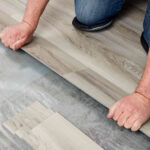
Pergo laminate flooring installs as a floating floor. The planks click together at the edges and sit on top of the subfloor without glue, nails, or staples, notes TE Johnson & Sons Greensboro. The entire floor floats as a single sheet held in place by its own weight and by the baseboards and trim around the perimeter. No plank is attached to the subfloor. This is the single most important concept to understand before you start. A floating floor expands and contracts with temperature and humidity. If you nail it, glue it, or wedge it too tightly against the walls, it will buckle.
Installing Pergo in a typical 150-square-foot room takes a day for one person, plus time for acclimation and trim work. The tools are basic. The technique is repetitive. The mistakes are predictable. Here is how to do it correctly.
Step One: Acclimate the Flooring
Pergo planks must sit in the room where they will be installed for at least 48 hours before installation. The boxes should be laid flat, not on edge, in stacks of no more than three boxes high, with space between the stacks for air circulation. The room temperature must be between 65 and 85 degrees Fahrenheit during acclimation and installation. The relative humidity must be between 35 and 65 percent.
Acclimation allows the planks to adjust to the room’s temperature and humidity. If you install Pergo straight from a cold warehouse into a warm house, the planks will expand after installation and buckle at the seams. If you install from a humid garage into an air-conditioned house, the planks will shrink after installation and leave gaps. The 48-hour minimum is not a suggestion. It is the manufacturer’s requirement, and skipping it voids the warranty and practically guarantees problems within the first season.
Step Two: Prepare the Subfloor
Pergo installs over most existing hard surfaces including plywood, OSB, concrete, vinyl sheet flooring, and ceramic tile. It does not install over carpet, carpet pad, or any surface that compresses under weight. The subfloor must be flat to within 3/16 inch over a 10-foot span. Check this with a 10-foot straightedge or a long level. Low spots must be filled with a cement-based floor leveling compound. High spots must be sanded or ground down. A subfloor that is not flat enough causes the click-lock joints to flex with every footstep. The joints eventually crack and the floor fails.
Sweep and vacuum the subfloor thoroughly. A single pebble or a drywall screw left on the subfloor will telegraph through the laminate as a visible bump and will eventually wear through the plank from underneath. Run your hand over the entire subfloor after vacuuming. You will feel debris that the vacuum missed.
Roll out the underlayment. Pergo planks with attached underlayment do not require a separate roll. Pergo planks without attached underlayment require a foam or combination foam-and-vapor-barrier underlayment. The underlayment smooths minor subfloor irregularities, reduces sound transmission, and provides a vapor barrier for installations over concrete. Roll the underlayment in the same direction as the flooring will run. Butt the seams together without overlapping. Tape the seams with the tape specified by the underlayment manufacturer. Trim the underlayment flush with the walls.
Step Three: Plan the Layout
Laminate flooring looks best when it runs parallel to the longest wall or parallel to the primary light source, which is usually the windows. Running planks perpendicular to the floor joists is not required for laminate because it is a floating floor. The structural reason for perpendicular installation applies only to nailed hardwood.
Measure the room width perpendicular to the plank direction. Divide by the plank width. If the last row will be less than 2 inches wide, you need to cut the first row narrower so that both the first and last rows are at least 2 inches wide. A very narrow last row is difficult to install, looks bad, and is more likely to separate at the joint. To calculate the first row width, subtract 2 inches from the last row width, divide by 2, and add the result to the last row width. Or simply divide the remaining width equally between the first and last rows. Both rows end up wider than 2 inches.
Remove baseboards or shoe molding before installation. Pergo requires a 1/4-inch expansion gap around the entire perimeter, including doorways, pipes, and transitions to other flooring. The gap is hidden by the baseboard or by quarter-round molding installed after the floor is laid. If you leave the baseboard in place, you must install quarter-round or shoe molding to cover the gap. If you remove the baseboard and reinstall it after the floor is down, the baseboard itself covers the gap and no additional molding is needed. Removing and reinstalling baseboard takes more time but produces a cleaner finish without the extra visual element of quarter-round.
Step Four: Install the Planks
Start in a corner and work left to right if you are right-handed, or right to left if you are left-handed. The tongue of the first row faces the wall. It will be cut off later because the expansion gap removes the need for the tongue on the first row. Place 1/4-inch spacers between the planks and the wall to maintain the expansion gap. Pergo sells spacers, or use scrap pieces of laminate turned on edge.
The short ends of the planks in each row click together first. Align the short end of the new plank at a 20 to 30 degree angle to the installed plank. Insert the tongue into the groove and fold the plank down flat. The joint clicks into place. Tap the long edge of the new plank with a tapping block and a hammer to close any gap at the short-end joint. Do not hit the plank directly with the hammer. Hit the tapping block. The tapping block is a scrap piece of laminate or a plastic tool that fits over the plank edge and protects the tongue from damage.
For the long edge, angle the entire row of planks toward the previous row. Insert the tongue into the groove along the entire length. Fold the row down flat. The long edges click together. Use the tapping block and a pull bar to close any gaps at the ends of rows. The pull bar is a flat metal hook that reaches into the expansion gap and allows you to tap the last plank in a row tight against the adjacent row when there is no room to swing a hammer directly.
Stagger the end joints. No two adjacent rows should have end joints that line up. The minimum stagger is 12 inches. A random pattern looks more natural than a repeating pattern. Use the cutoff piece from the end of one row to start the next row if it is at least 12 inches long. This reduces waste and creates a random stagger automatically.
Cut planks to length with a miter saw, a circular saw, a jigsaw, or a laminate cutter. A laminate cutter is a guillotine-style tool that shears the plank without producing dust. It costs $30 to $50 and is worth buying if you are installing more than one room. A power saw produces fine dust that gets everywhere. Cut planks face-up with a miter saw or circular saw to minimize chipping on the finished surface. A fine-tooth blade designed for laminate or plywood produces the cleanest cut.
The last row almost always requires ripping planks lengthwise. Measure the gap between the second-to-last row and the wall at multiple points along the wall. Walls are rarely straight. The gap will vary. Subtract the expansion gap, 1/4 inch, from the measured distance at each point. Mark the rip line on the plank and cut. Install the final row with a pull bar because there is no room to use a tapping block against the wall.
Step Five: Transitions, Trim, and Doorways
Install transition strips where the laminate meets another type of flooring, such as carpet, tile, or vinyl. Pergo sells matching transition strips in T-molding for same-height transitions, reducer strips for transitions to lower flooring, and end caps for transitions to exterior doors, sliding glass doors, and fireplaces. The transition strip is not attached to the laminate. It is attached to the subfloor with a metal track that is screwed or glued down. The laminate floats underneath the transition. The gap between the laminate and the track allows the laminate to expand and contract independently of the fixed transition.
Reinstall baseboards or install quarter-round molding to cover the expansion gap. Nail the molding to the wall, not to the floor. Nailing through the laminate into the subfloor locks the floating floor in place at the perimeter and prevents it from expanding and contracting. The floor will buckle at the first significant temperature change. The molding is attached only to the wall or the baseboard, never to the floor.
At doorways, undercut the door casing and the door jamb so the laminate slides underneath. An oscillating multi-tool with a flush-cut blade is the best tool for this. Place a scrap piece of laminate and underlayment against the door casing as a height guide. Cut through the casing and jamb at that height. The laminate slides under the casing, eliminating the need for a difficult scribe cut around the molding. The expansion gap is hidden under the casing and the door trim.
Common Mistakes
Skipping the acclimation period or shortening it because the room feels dry. Two days is the minimum. In a humid climate or a house without air conditioning, extend it to 4 or 5 days. Sliding furniture across the floor without felt pads. Laminate is durable but not indestructible. A table leg dragged across the floor leaves a scratch that cannot be sanded out the way solid wood can. Install felt pads on every furniture leg before placing it in the room. Wet-mopping the floor. Laminate is water-resistant, not waterproof. Standing water seeps into the joints and swells the fiberboard core. The damage is permanent. Clean with a damp mop, not a wet mop. Wipe up spills immediately.
Frequently Asked Questions
Which direction should I run the flooring?
Parallel to the longest wall, or parallel to the primary light source, which is usually the windows. Running parallel to the longest wall makes the room look longer. Running perpendicular to a large window shows fewer gaps at the short-end joints because the light strikes the joints at a glancing angle rather than across them. Both are valid. Choose the orientation that works best for the room shape and the primary light direction. Running planks on a diagonal adds significant waste from angled cuts and is not recommended for a first-time installer.
Can I install Pergo in a kitchen or bathroom?
Pergo makes water-resistant laminate rated for kitchens and bathrooms. Standard laminate is not rated for these rooms. The water-resistant products have a treated core and a wax-sealed joint that resists water penetration. They can handle the occasional splash and spill in a kitchen or a half bath. They are not rated for a full bathroom with a shower or tub where standing water and high humidity are constant. If the room has a moisture source that generates steam, such as a shower, choose luxury vinyl plank instead of laminate.
My subfloor is concrete. What do I do differently?
Install a vapor barrier underlayment, typically 6-mil polyethylene sheeting, over the concrete before rolling out the foam underlayment. The vapor barrier prevents moisture from the concrete from reaching the laminate and swelling the core. The vapor barrier sheets must overlap by at least 6 inches at the seams. Tape the seams with waterproof tape. Run the vapor barrier up the walls 2 inches and trim after the floor is installed. The 2-inch lip prevents moisture from wicking up the edge of the laminate at the perimeter. If your Pergo planks have attached underlayment, check the manufacturer’s instructions. Some attached underlayments include a vapor barrier and do not require a separate polyethylene sheet. Others require an additional vapor barrier over concrete.
Last modified: June 27, 2026