The vinyl plank flooring box says a beginner can install fifty square feet per hour. That number assumes the subfloor is flat, the room is an empty rectangle, the planks click together without resistance, no cuts are needed around doorways or vents, and you are measuring your time from the moment you snap the first plank together, not from the moment you start moving furniture out of the room. The actual time to install vinyl plank flooring in a lived-in house, measured from moving the first piece of furniture to sweeping the floor after the last piece of quarter-round is nailed in place, is about double to triple the installation rate on the box, and the extra time is not wasted, notes Legacy Realty & Management, a trusted Allen property management. It is spent on the tasks that determine whether the floor looks professionally installed or like a first attempt.
Vinyl plank flooring is the fastest flooring to install after carpet, and it is the most forgiving for a first-timer. The planks cut with a utility knife, they click together without glue, and they can be walked on immediately after installation with no drying or curing time. A single room of about a hundred and fifty square feet, a typical bedroom, can be installed by a first-timer in a day, including furniture moving, old flooring removal, subfloor prep, plank installation, and trim replacement. A larger project, like an open-concept living area of five hundred square feet with a kitchen island, multiple doorways, and floor vents, takes a first-timer a full weekend of two long days.
The Prep Work — The Hours Before the First Plank Clicks
Furniture removal takes thirty minutes to an hour depending on how much furniture is in the room and whether you have somewhere to put it. The furniture from a bedroom can be moved into the hallway or an adjacent room. The furniture from a living room with a sectional sofa, a media console, and a bookshelf needs a garage or a PODS container. Moving furniture out of the work area is not optional. Installing flooring around furniture is slower than moving the furniture, and the result is a floor with cuts that wander because you were working in a three-foot gap between a couch and a wall.
Removing the old flooring takes one to three hours for carpet and pad, which pull up and roll away, and three to six hours for glued-down vinyl, tile, or hardwood, which must be pried up, scraped, and disposed of. Carpet removal includes pulling out the tack strips along the walls, which are nailed into the subfloor and will tear the bottom of a vinyl plank if stepped on with a plank in hand. The tack strip removal alone takes about fifteen minutes per room. The old flooring and the debris must be hauled out of the house. The time to carry rolls of old carpet to the curb or load them into a truck is not included in the installation rate on the box.
Subfloor preparation takes thirty minutes to two hours depending on the condition of the subfloor. A flat, clean plywood subfloor in a newer house needs sweeping and possibly a few screws driven into squeaky spots. A concrete slab with cracks needs crack filler and a moisture barrier. A plywood subfloor with high seams between the sheets needs sanding or patching with floor leveler. Vinyl plank flooring requires a subfloor flat to within three-sixteenths of an inch over a ten-foot span. A subfloor that does not meet that standard must be leveled before the first plank is laid. Leveling compound adds a day to the project because it must cure, typically four to six hours, before flooring can be installed over it.
Installation Speed — The Real Rate for a First-Timer
Click-lock vinyl plank flooring installs at a rate of about twenty-five to forty square feet per hour for a first-timer in a rectangular room with no obstacles. The first few rows are slow, about fifteen to twenty square feet per hour, because you are learning the locking mechanism, figuring out the tapping pressure, and establishing the reference line. The middle rows speed up to about forty to fifty square feet per hour because the pattern becomes repetitive and the cuts are mostly straight end cuts. The last few rows slow down again because you are cutting the final row to width, working against the wall, and maneuvering the last planks into place with a pull bar.
Every obstacle in the room reduces the installation rate. A doorway adds about ten to fifteen minutes to measure, cut the plank to fit around the door casing, and undercut the casing so the plank slides underneath it. A floor vent adds about ten minutes to measure, mark, and cut the rectangular opening. A closet adds about thirty minutes for a small reach-in closet because the space is tight and every plank requires a cut. A kitchen island or a peninsula with cabinets adds about an hour because the flooring must be installed around three or four sides of the obstacle, with every perimeter plank requiring a cut.
| Room scenario | Size | First-timer install time | Total project time (incl. prep) |
| Empty rectangular bedroom | 150 sq ft | 4–6 hours | 6–8 hours (1 day) |
| Bedroom with closet, 1 doorway | 150 sq ft | 5–7 hours | 8–10 hours (1 long day) |
| Living room, 2 doorways, 2 vents | 300 sq ft | 8–11 hours | 12–16 hours (2 days) |
| Open plan with kitchen island | 500 sq ft | 13–18 hours | 18–24 hours (2–3 days) |
Trim Work — The Part That Takes as Long as You Let It
Reinstalling or replacing baseboards and quarter-round takes one to three hours depending on the size of the room and whether you are reusing the old trim or installing new. Reusing old trim means pulling the nails through the back of the trim with pliers, filling the nail holes, and touching up the paint. Installing new trim means measuring, cutting miter joints, nailing, filling nail holes, and painting. New trim looks better. Old trim is faster and free.
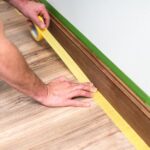
Quarter-round molding, the curved molding at the base of the baseboard that covers the expansion gap between the flooring and the wall, is the standard finishing detail for vinyl plank flooring. It is installed after the flooring is complete, nailed into the baseboard, not the floor, so the flooring can expand and contract underneath it. Cutting quarter-round to fit around door casings and inside corners adds about thirty minutes per room. Caulking the top edge of the quarter-round where it meets the baseboard and the bottom edge where it meets the floor, painting or touching up the nail holes, and cleaning up the caulk mess adds another thirty minutes. The trim work alone, done carefully, takes about as long as installing the flooring in a small room.
Acclimation — The Waiting Period
Vinyl plank flooring does not require the same acclimation period as hardwood or laminate, but it does need to adjust to the room temperature. Most manufacturers recommend leaving the unopened boxes of flooring in the room where they will be installed for at least forty-eight hours before installation. The acclimation period is not dead time. It is the window during which furniture is moved, old flooring is removed, and the subfloor is prepared. The acclimation and the prep work should happen simultaneously so neither adds elapsed time to the project.
The one exception is installing vinyl plank flooring in a space that is not climate-controlled, such as a three-season porch or a basement that is not heated in the winter. The flooring must be installed within the manufacturer’s specified temperature range, typically between sixty-five and eighty-five degrees Fahrenheit, and the room must be brought to that temperature and held there for the acclimation period and the installation. Installing vinyl plank flooring in a cold room causes the planks to contract after installation, opening gaps between the planks. Installing in a hot room causes the planks to expand after installation, buckling the floor.
FAQ — Vinyl Plank Installation Time
Is glue-down vinyl plank flooring faster or slower than click-lock?
Slower. Glue-down vinyl plank requires spreading adhesive on the subfloor, waiting for it to become tacky, and placing each plank individually with pressure to bond. The adhesive open time limits how much flooring can be installed in a session, and the adhesive must cure before the floor can be walked on, which adds a day to the project. Click-lock flooring is installed dry and can be walked on immediately. Glue-down is selected for its durability and moisture resistance, not for its installation speed.
Can a single room really be done in one day?
A bedroom with the furniture already moved out, the old carpet already removed, and the subfloor already prepped can be floored in about four to six hours by a first-timer. A bedroom where you arrive in the morning and do everything from start to finish, including moving furniture, pulling carpet, pulling tack strips, sweeping the subfloor, installing the flooring, and reinstalling the baseboards, takes a full day of eight to ten hours. The prep work is what separates the one-day project from the weekend project.
How much faster is a professional installer?
A professional flooring installer can install about a hundred to a hundred and fifty square feet of click-lock vinyl plank per hour in an empty room with a clean subfloor. That is about three to four times faster than a first-timer. The speed difference comes from experience with the locking mechanism, the ability to measure and cut planks without trial-fitting, and the physical pace of working on your knees for eight hours a day. A professional crew of two can install five hundred square feet of vinyl plank flooring in a single day from bare subfloor to finished floor.
Last modified: June 27, 2026